
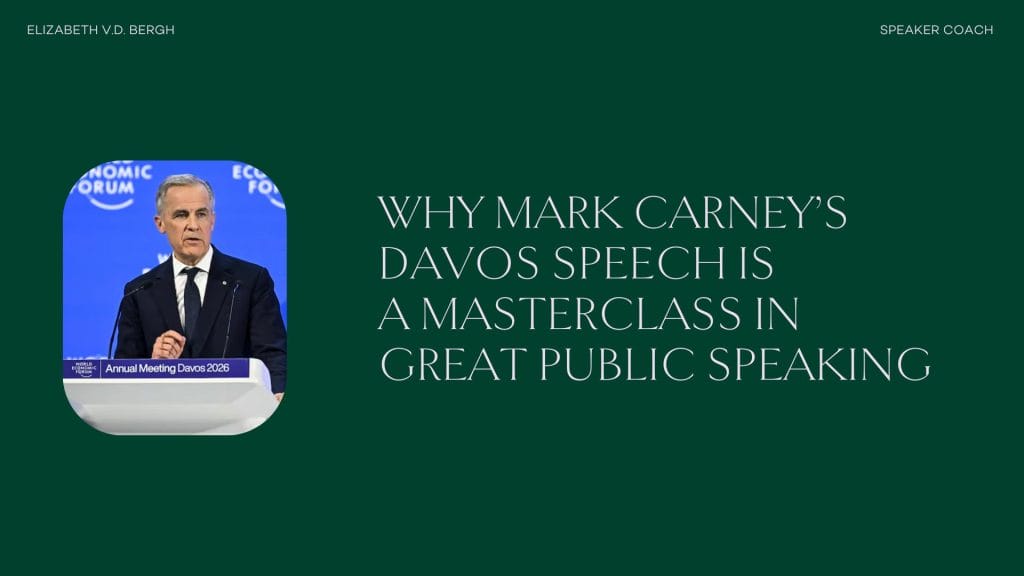
This is the kind of political leadership we need today. It is precise, elegant, brutally honest, courageous, self reflective, accountable and does not hold back.
Canadian Prime Minister Mark Carney gave us strategic clarity. And this has been rare among world leaders and national politicians. They don’t always approach public speaking with the dedication it deserves.
In this article, I share insights that serve as public speaking tips for executives, experts and founders. It is rare to see a leader deliver a speech that doubles as a masterclass in great public speaking.
Carney’s speech is brilliant because it is built on deep thought and vision.
A great speech starts with powerful presence
Before diving into the content, check his body language: his posture, his demeanour, the eye contact. This is a man who is composed and contained.
He embodies powerful presence: showing up courageously and intentionally. Speaking from a place of calm and control.
Carney is confident and knows exactly where he is going. Applying the “always be making your point” rule. This is what drives clarity.
A great speech has strong statements.
“Nostalgia is not a strategy.”
He officially declared the world order dead and ruptured – a truth nobody could no longer deny.
Also, this is a big sneer to the extreme right, whose vision is to go back to an imaginary and romanticized past.
“Compliance will not buy safety.”
Reminding us that we need to be more courageous. And that doing nothing and waiting is a dangerous strategy.
“This speech is planting a flag.”
This is full on: giving importance to your words. And positioning your speech.
“Middle powers must act together because if you are not at the table, you are on the menu.”
Calling for solidarity. And stepping away from many leaders’ natural reaction to fall back on oneself. But isolation and inaction are never a good idea.
A great speech has a strong opening and a convincing structure
He frames the situation perfectly using the story of Vaclav Havel :
Every morning the shopkeeper places a sign in the window ‘workers of the world unite’.
He doesn’t believe it, no one does, but places the sign anyway in the window to avoid trouble.
This story is used to reframe the entire geopolitical situation.
And Carney uses it to deliver this call to action: it is time for companies and countries to take their sign down, right at the beginning of the speech. Hence applying “always start strong”.
He gives the answer and then spends 20 minutes elaborating why.
Then he follows the perfect three act structure:
Act 1: Diagnose
We placed the sign in the window, we participated in the rituals, and we largely avoided calling out the gaps between rhetoric and reality.
Act 2: The plan
Our new approach rests on what Alexander Stubb the president of Finland has termed value-based realism. Or to be put another way, we aim to be both principled and pragmatic.
Bringing up a contrast, which inherently carries tension and which is to be navigated.
How to maintain principles when rules no longer protect you.
Act 3: The Vision
“We know the old order isn’t coming back. We shouldn’t mourn it. Nostalgia is not a strategy.
But we believe that from the fracture we can build something bigger and better, stronger.”
Great leaders show a way out. Not sugarcoating, yet giving clear direction.
Bigger, better, stronger: beautiful use of the rule of three
Inviting others to join.
Personally, I would have suggested the structure: Diagnose, Vision, Plan. First, presenting the vision, then painting the picture of how to bring it to life.
Great speakers use rhetoric figures
Anapohora: repetition at the beginning
to go along to get along
to accommodate to avoid trouble
Epistrephe repetition at the end
you cannot live within the lie of mutual benefit through integration. When integration becomes the source of your subordination.
I truly hope Canadian Prime Minister Mark Carney inspired many into thinking and acting differently: with vision and courage.
We placed the sign in the window, we participated in the rituals, and we largely avoided calling out the gaps between rhetoric and reality.
- Act 2: The plan